
Art & Culture
The Australian Landscape Tradition in Painting
1 June 2026
The Colonial Beginnings: When the Land Was Strange
European settlers rocked up to Australia dragging British landscape painting conventions with them. They expected picturesque compositions and pastoral scenes, nature all neat and ordered. What they actually found threw them completely. The light was harsher and brighter than England, the trees and animals were nothing like home, and the sheer scale of the place was bewildering. Artists like Thomas Watling and John Lewin had to figure out how to paint this alien world using techniques designed for somewhere else entirely. It was genuinely hard slog.
The early painters mostly worked in watercolour, which let them capture the Australian light and the intricate detail of native plants pretty well. They combined careful observation with romantic notions, trying to record what was actually there while making it comprehensible back in Britain. You can see the tension in their work. Some paintings treat the landscape as window dressing for European settlement or mining operations. Others show the artists beginning to really notice what made the Australian environment visually distinct. Pieces in the Art Gallery of New South Wales and the National Gallery of Australia in Canberra illustrate this transition, this moment when one culture was learning to see the world through another culture's eyes.
The Heidelberg School and the Birth of Australian Landscape Identity
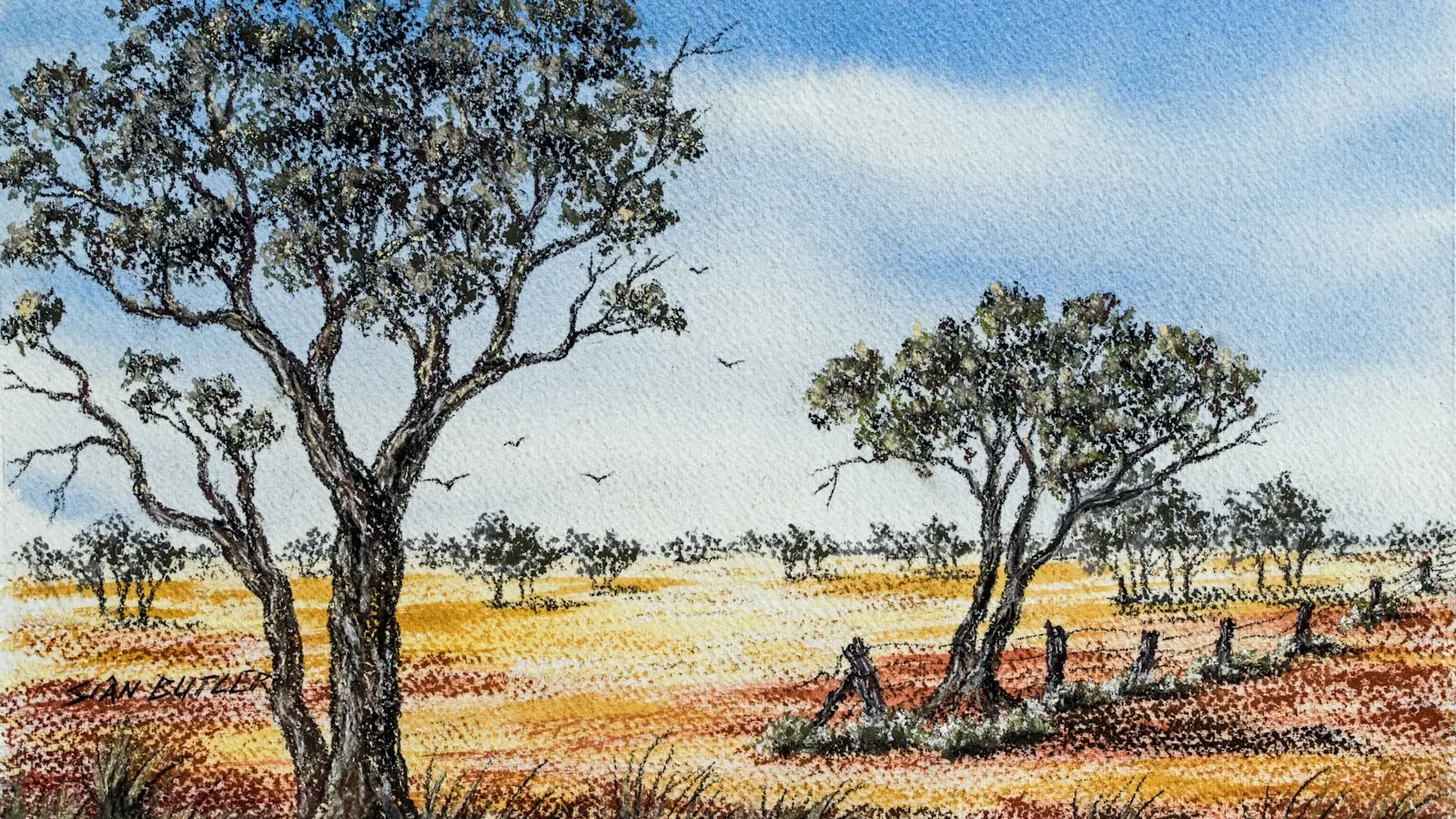
In the 1880s and 1890s, things changed. Arthur Streeton, Frederick McCubbin, and Tom Roberts started hanging around Heidelberg, a small township outside Melbourne. They ditched the studio approach of the European tradition and went outside to paint instead, working straight from what they saw. They paid close attention to how light shifted and changed throughout the day. For Australian art, this was a big deal. These painters reckoned the Australian landscape was genuinely worth looking at, worth painting seriously. Their work captured something true about Australian light: the way it hits eucalyptus, the warmth of ochre dirt, the colours you actually see in native plants.
The Heidelberg School was deliberately Australian, and they were pretty conscious about it. These blokes wanted to make art that belonged to this place, not to Europe. Streeton's 'Fire's On' and McCubbin's 'Lost!' aren't just pleasant paintings. They're actually arguments about what Australian landscape art ought to be. The moment mattered too. It was the 1890s, just before Federation, when Australians were starting to think about what being Australian actually meant. The paintings sold well locally, people bought them, and it turned out there was genuine appetite for landscape art that spoke to Australian life.
What the Heidelberg School did stuck around. The way they used colour, the practice of painting from life, the focus on the Australian bush shaped Australian art for decades. The National Gallery of Victoria has masses of their work, and these paintings remain some of the most recognisable and loved pieces in Australian art.
Modernism and the Reinvention of Landscape
Twentieth century Australia saw artists returning from overseas with fresh knowledge of Impressionism, Post-Impressionism, and modernism. Rather than simply copying European styles, they took what they'd learned and adapted it to Australian light and conditions. Grace Cossington Smith exemplified this shift. She painted Australian gardens and interiors with bold colour and expressive brushwork, aiming to convey feeling and atmosphere rather than faithful representation. Her work signalled a fundamental break from the old landscape tradition, opening it up to reinvention.
The World Wars disrupted everything. Artists who'd served came back with altered perspectives on the world around them. From the 1940s through the 1950s, painters like Russell Drysdale and Albert Namatjira engaged seriously with modernism while also grappling with Indigenous approaches to country. Drysdale's outback towns, with their strange angles and scorched colours, felt distinctly Australian: neither European nor Aboriginal, but something genuinely in between. Namatjira's watercolours of the West Macdonnell Ranges demonstrated that landscape could bridge Aboriginal and non-Aboriginal understanding, though his own life revealed the harsh boundaries of that bridge in his era.
By the 1960s and 1970s landscape painting had grown vastly more complex and intellectually demanding. Artists began questioning what landscape painting actually was and what it meant to depict Australia. Abstraction, colour field work, and new spatial treatments emerged across the field. The old tradition didn't fade away. It was simply being rebuilt from scratch into something altogether different.
Regional Traditions: From Tasmania to Tropical Queensland
Tasmania's got a pretty distinct landscape painting tradition thanks to the size of Australia and how different each region is. Artists have always gravitated toward the dramatic coastlines, the cool light, and those cool temperate rainforests. The landscape there just looks and feels different from that sunburnt inland stuff you see in other parts of the country. Painters working in Tasmania today still reckon there's heaps to explore there. The Tasmanian Museum and Art Gallery in Hobart holds some significant collections that show how this regional tradition actually developed.
South Australia, particularly around the Barossa Valley and Adelaide Hills, has carved out its own thing centred on wine country and agricultural landscape. Artists like Jane Arden and Hans Heysen made South Australian landscapes their focus, working through how to capture the relationship between farmed land and wilderness, human effort and natural forms. The light tends to be softer and the terrain gentler than in the more dramatic parts of Australia, and that's really shaped how artists in the region approach their work.
Queensland's tropical and subtropical areas have their own distinct artistic traditions. The lush colours, dramatic storms, and particular quality of light in the north have drawn artists looking for something visually different from the arid inland image most people think of. The Mackay region, rainforest areas, and north coast all present different aesthetic challenges and possibilities. Recently, artists have started engaging with how climate change and environmental damage are altering these regional identities, creating landscape paintings that manage to be both beautiful and politically engaged.
How Contemporary Artists Rethink Landscape
Today's Australian artists treat landscape on their own terms. Some still paint or draw what they see, but there's more intellectual weight to it. Others use landscape as a way in to talk about identity, environment, colonisation, and belonging. Rover Thomas, Patricia Piccinini, and Nick Mangan each do something different with it, and none of them fit neatly into a box.
The tools have changed. Digital cameras, video, installations, and computer-based work are standard now. But the old ways haven't disappeared. Painters, printmakers, and draughtspeople are still going strong. Printmaking's had a real comeback in particular, with artists discovering fresh possibilities in etching, lithography, and screen printing. You'll see contemporary landscape work hanging in every major Australian gallery, which says something about how far from dead this tradition is.
These days, environmental politics matter more than aesthetics alone. Climate change is real and visible, and artists are using landscape to ask hard questions about it. This is serious, political work about our relationship with the environment, the aftershocks of colonisation, and what we might build next. Some collaborate directly with Indigenous artists and communities, trying to get away from European ways of seeing landscape and instead bring Aboriginal knowledge systems to the front.
What to Look For: Developing Your Eye for Australian Landscape Art
Getting a grip on the history and traditions of Australian landscape painting really helps if you're a collector, student, or just keen on the work. When you're looking at a landscape painting, ask yourself what period it's from and what artistic movements were going on then. Does it follow the Heidelberg School playbook, or is the artist trying to do something different? How connected was the artist to the place they painted? You want to know if there's genuine emotional or conceptual engagement happening, or whether the landscape is mainly just an excuse to mess around with formal stuff like colour and composition. The way an artist handles light, tone, and perspective tells you a lot about what matters to them.
The major Australian galleries are where you'll see the serious stuff. The National Gallery of Australia in Canberra has the country's largest collection of Australian landscape art, going right back to colonial times. Sydney's Art Gallery of New South Wales, the National Gallery of Victoria in Melbourne, and the Art Gallery of South Australia in Adelaide all hold proper collections too. Regional galleries can be really useful because they tend to focus on local traditions and show you how artists were shaped by the places around them.
But nothing beats visiting the actual country the artists painted. The landscapes Streeton, McCubbin, and Roberts worked from are still there and haven't changed that much. Walking through the same scrub and valleys they painted gives you something you can't get from a gallery. You start to understand what caught their eye and how they managed to turn that experience into something on canvas. Looking at focused exhibitions, reading what the artists themselves had to say about their work, checking out the catalogues, and getting stuck into some proper art history writing all add layers to what you're seeing.
Indigenous Perspectives and the Future of Landscape Tradition
You can't seriously look at Australian landscape art without facing up to what Indigenous perspectives tell us. Aboriginal Australians have been shaped by their relationships with land over tens of thousands of years in ways that run deep and complicated. Artists like Emily Kame Kngwarreye, Rover Thomas, and Gina Adams have changed how we think about and paint landscape in contemporary Australian art. Their work does more than just look good. It engages with Country through Indigenous knowledge systems, spiritual relationships, and histories of survival and resistance that shape what they're doing.
Australian art history is shifting away from treating landscape as one tradition. Now it's being written and taught as multiple traditions. Galleries and museums are actively working to decolonise their collections and exhibitions, moving past narratives centred on European settlement. They're opening up to more inclusive understandings of who lived on and represented this land. That's sparked rich conversations between Indigenous and non-Indigenous artists, curators, and institutions, though real decolonisation still has a long way to go.
The future of Australian landscape painting will probably keep building on dialogue between different traditions and approaches. Contemporary artists show that landscape is still a vital medium for working through urgent questions about environment, identity, and where we belong. Rather than just repeating what came before, they're transforming inherited traditions, making art rooted in Australian place-experience while staying connected to global artistic movements and concerns. As this conversation between past and present, between different cultural perspectives, continues, landscape stays central to how Australia sees itself through visual art.
The Market and Collecting: Practical Considerations
If you're thinking about collecting Australian landscape art, you need to do your homework. Major auction houses regularly shift Australian landscape paintings, from old works through to recent stuff. Art fairs and gallery shows let you scope out what's available and get to know dealers and galleries who specialise in different periods. Before anything else, build some real knowledge about the art. Collections that start as investment plays often end up as regret, but collections built on genuine interest in the work itself tend to pay off better in the long run.
When you're looking at buying something significant, talk to a professional. Art consultants, curators, and dealers who know their stuff can help you figure out authenticity, condition, what it's worth in the market, and whether it fits your collection. For older works like Heidelberg School paintings or early twentieth-century modernists, provenance matters a lot. A work's exhibition history and who's owned it before tells you plenty about whether it's legitimate and why it matters. Getting proper condition reports, sorting out documentation, and investing in good framing and care keeps the work in shape and maintains its value over time.
Get to know galleries and institutions around Australia, from the big national museums down to regional galleries and artist-run spaces. Plenty of them run talks from artists, education programs, and conservation demos that really help you understand landscape art and what's happening in the scene now. Building connections in the Australian art world, whether as a collector or just someone interested in the work, opens doors you wouldn't get from just buying and selling. The landscape tradition in Australian art is still going strong and genuinely welcomes people who come to it with a genuine interest and respect.